
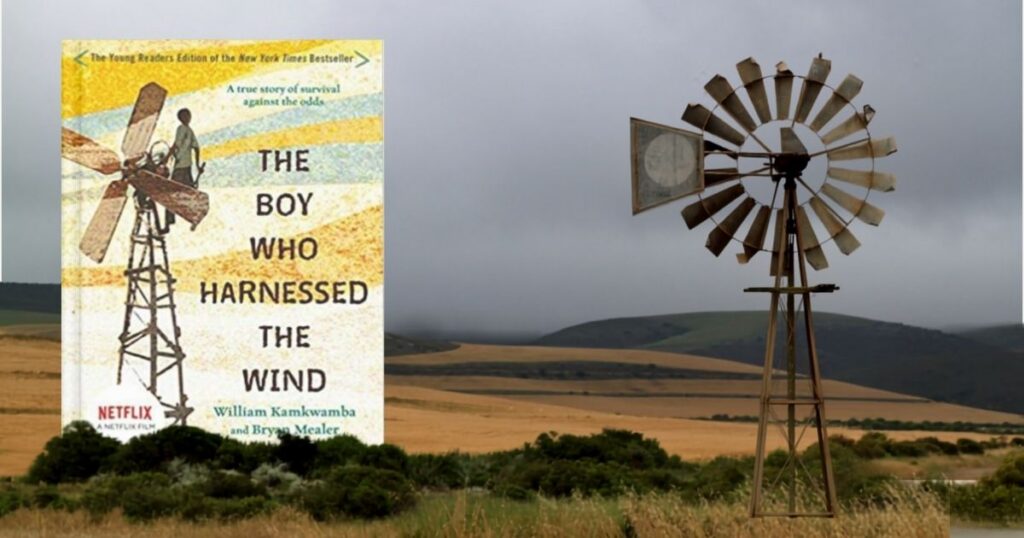
One of my favorite things about a really good book is that it doesn’t end when you close the cover.
The best books leave your kids thinking. They ask questions at dinner. They bring something up three days later that you thought they had forgotten. They suddenly want to know how wind turbines work, where Malawi is, or whether they could build something useful out of the random pile of cardboard and broken gadgets in the garage.
The Boy Who Harnessed the Wind is exactly that kind of book.
William Kamkwamba’s story is full of the things I want my kids to encounter in their reading: perseverance, ingenuity, hardship, responsibility, curiosity, and the idea that knowledge can actually be used to serve other people.
And if you homeschool—or even if you simply want to make more out of the books your kids are already reading—this one gives you so many natural places to go next.
You do not need to turn every book into a full-blown unit study. Sometimes a good conversation is enough, but when a child is interested, I love giving them a way to follow that interest a little farther.
So I put together a list of projects inspired by The Boy Who Harnessed the Wind. There are simple projects for younger kids, more involved ideas for middle schoolers, and some genuinely challenging options for teens.
Pick one. Pick three. Let siblings work at different levels, or simply hand your child the list and see what catches their attention.
Easy Projects
These are good choices for younger kids, reluctant project-doers, or families who want to keep things simple.
1. Build a Mini Windmill
Give your child paper, cardboard, straws, craft sticks, recycled materials, or whatever you have on hand and let them build a windmill.
This does not need to be beautiful.
In fact, I think it is better when kids have to look around and figure out what they can use.
That resourcefulness is a big part of William’s story.
2. Make a Timeline of William’s Story
Have your child create an illustrated timeline of the major events in William’s life and the steps that eventually led to his windmill.
For younger students, this can be very simple. Older kids can add dates, historical events, or details about what was happening in Malawi at the time.
3. Create a Book Poster
Instead of a traditional book report, let your child make a poster about the book.
They can include favorite quotations, important themes, drawings, symbols, character traits, or scenes that stood out to them.
4. Invent Something Powered by Wind
Ask your child:
If you could use wind to power something useful, what would you build?
Let them sketch their idea, label the parts, and explain what problem it would solve.
It does not have to be realistic at first. The point is to start thinking like an inventor.
5. Try a Recycled-Materials Challenge
William did not have a well-stocked science lab or a box of brand-new engineering supplies. He used what he could find.
Give your child a collection of recycled materials and challenge them to make something useful.
Cardboard, bottle caps, string, old containers, broken toys, rubber bands, and scraps can suddenly become very interesting when there is a problem to solve.
6. Make a Character Trait Board
Choose several traits that describe William—perhaps perseverance, curiosity, courage, creativity, or determination.
Then have your child find examples from the book that show those qualities.
This is a simple way to practice using evidence from a text without making the assignment feel like another worksheet.
Medium Projects
These ideas work especially well for upper elementary and middle school students, although younger kids can certainly try them with help.
7. Find Out Which Windmill Blade Works Best
Build several windmills with different blade shapes, lengths, or angles.
Then put them in front of a fan and see what happens. Which spins fastest? Which starts moving with the least amount of wind? What happens when you change the angle of the blades?
If your child enjoys science, this can easily become a real experiment with a hypothesis, recorded results, and graphs.
If not, simply observing and talking about the differences is still worthwhile.
8. Learn How a Modern Wind Turbine Works
After reading about William’s homemade windmill, your child may be curious about the enormous wind turbines we see today.
Have them research how a modern turbine turns moving air into electricity and then explain it with a diagram, model, slideshow, or short video.
One of the things I like about this project is that it helps kids connect something they read in a book with technology they may have seen in real life.
9. Do a Home Energy Audit
Have your child look around your house and notice where electricity is being used.
Which appliances use the most energy? Are lights left on? Are devices plugged in all day? Could anything be changed?
Then ask them to come up with a realistic plan for reducing your family’s energy use.
You may or may not decide to follow all their recommendations, but they will probably start noticing your thermostat.
10. Solve a Problem in Your Own Community
William did not build something simply because building was interesting. There was a real problem that needed to be solved.
Ask your child to look around and identify a problem they notice.
It might involve water, food, electricity, transportation, gardening, waste, accessibility, animals, or something in your own home.
Then have them design a low-cost solution. That shift—from “make an invention” to “solve a problem”—can lead to much deeper thinking.
11. Learn More About Malawi
It is easy for kids to read a story set somewhere unfamiliar without really understanding the place.
Spend some time learning about Malawi itself. Look at maps. Find photographs. Learn about the climate, agriculture, languages, food, geography, and everyday life.
Then talk about how those things help your child understand William’s story differently.
This is one of those projects that can quietly turn literature into geography, history, and cultural study without needing separate lessons for each subject.
12. Interview Someone Who Solves Problems for a Living
Engineers are not the only people who solve problems.
Farmers do it. Mechanics do it. Electricians do it. Builders do it. Nurses do it. Small-business owners do it.
Have your child interview someone you know who regularly has to figure things out.
Ask how they approach a problem when they do not immediately know the answer.
Then compare their process with William’s.
13. Create a News Report from William’s Village
Let your child pretend to be a reporter covering events from the book.
They could create a newspaper front page, record a podcast, film a news report, or write an article.
This works particularly well for kids who enjoy storytelling more than traditional written assignments.
Hard Projects
These are good options for teens, science-loving kids, co-ops, or students who want a bigger challenge.
14. Build a Wind Turbine That Produces Electricity
Instead of simply making something that spins, challenge your child to build a small turbine that can actually generate measurable electricity.
Depending on your supplies, they could try to light an LED or use a multimeter to measure voltage. And here is the important part:
Do not stop when the first design does not work. That is actually where the interesting part begins.
Test it. Change something. Try again.
William’s story is a wonderful reminder that failure is often just part of figuring something out.
15. Conduct a Wind Turbine Experiment
Have your student choose one variable to test.
They might change:
- the number of blades
- the blade length
- the blade shape
- the blade angle
- the material
- the wind speed
Then they can collect data, graph the results, and explain what they discovered.
This can easily become a science fair project.
16. Compare Different Sources of Energy
Have your teen compare wind, solar, hydroelectric, biomass, and fossil fuels.
Instead of simply asking which one is “best,” have them look at the tradeoffs.
What does each one cost? Where does it work well? How reliable is it? What infrastructure does it require? What environmental effects does it have?
Real-world problems rarely have one perfect answer, and this is a good opportunity for teens to practice thinking through competing considerations.
17. Design a Solution for a Rural Community
Ask your teen to research the needs of a rural community and design a practical solution involving electricity, irrigation, clean water, agriculture, or food storage.
Require them to think beyond the idea itself.
What materials would be needed?
How much might it cost?
Who would maintain it?
Could local people repair it?
What happens when something breaks?
Those questions turn a creative idea into an engineering problem.
18. Design a Wind-Powered Water Pump
Wind does not have to become electricity before it can be useful.
Challenge your student to design a model showing how wind could be used mechanically to pump or move water.
This is a great project for a child who enjoys machines, gears, or figuring out how things move.
19. Create an Innovation-on-a-Budget Challenge
Give your student a fictional (or real) budget and a list of available materials. Then give them a problem to solve.
The catch: they cannot simply buy their way out of it.
They have to stay within the budget and use the materials available.
That constraint makes the project much closer to the kind of problem-solving William had to do.
20. Develop a Community Energy Plan
Have your teen imagine that they have been asked to help a small community meet its energy needs.
They need to determine what the community actually needs and then design a reasonable system.
Their proposal could include wind, solar, batteries, mechanical systems, or a combination.
Have them include estimated costs, benefits, drawbacks, maintenance needs, and diagrams.
This can become a substantial high school project that combines science, writing, math, economics, and research.
21. Take an Idea All the Way to a Prototype
For the most open-ended project, let your student choose a real problem and work through the entire design process.
Identify the problem.
Research it.
Brainstorm several possible solutions. Choose one. Sketch it. Build it. Test it. Discover what does not work. Change it. Test it again.
Then present the finished design and explain what they learned along the way.
That last part matters.
The goal is not necessarily to produce an amazing invention.
The goal is to learn how to keep going when the first idea does not work.
You Can Use the Same Project With Different Ages
If you have several kids at home, you do not necessarily need three completely different assignments.
You can take one idea and change the expectations.
For example:
A younger child: Build a windmill and explain what makes it move.
A middle schooler: Build several windmills, test them, and compare the results.
A teenager: Build a turbine that produces measurable electricity, record data, revise the design, and explain why the changes improved—or did not improve—its performance.
Everyone can be studying the same idea without everyone doing the exact same work.
That is one of the things I love about homeschooling with good books.
A single story can become literature for one child, science for another, history for another, and the beginning of a three-day building project for the kid who has now taken over the kitchen table.
The Project Is Not Really the Point
I love hands-on projects, but I do not think every good book needs an elaborate activity attached to it.
The book comes first.
Read it. Talk about it. Let your kids wrestle with the story.
Then, if something sparks their curiosity, follow it.
Maybe they build a windmill.
Maybe they spend an afternoon learning about Malawi.
Maybe they start taking apart an old fan because they suddenly need to understand the motor.
Maybe the only thing you do is have a long conversation about what it means to keep learning when the people around you think your idea is impossible or unrealistic. That counts too.
The real gift of a book like The Boy Who Harnessed the Wind is not that it gives us another science project to complete.
It shows our children what curiosity, perseverance, knowledge, and responsibility can look like in the life of a real person.
These are the kinds of ideas that they carry with them long after the book goes back on the shelf.
Which one of these are you choosing?